
Plug-in solar is now legal in Great Britain — but no kit has been confirmed compliant yet
✓ The law changed on schedule. SI 2026/848 — amending the Plugs and Sockets etc. (Safety) Regulations 1994 — came into force on 27 August 2026. A certified kit (up to 800 W, batteryless, meeting the finalised Interim Product Specification v2, on a factory-fitted BS 1363 plug) can now legally connect through a standard socket. The catch: at our last check, three microinverters had been registered on the ENA Type Test Register under the plug-in solar category — and all three were still assessed non-compliant. Zero kits are confirmed ready to buy and self-install. Realistic availability: autumn 2026.
🔍 See our live certified-kits tracker →·Balcony solar guide →
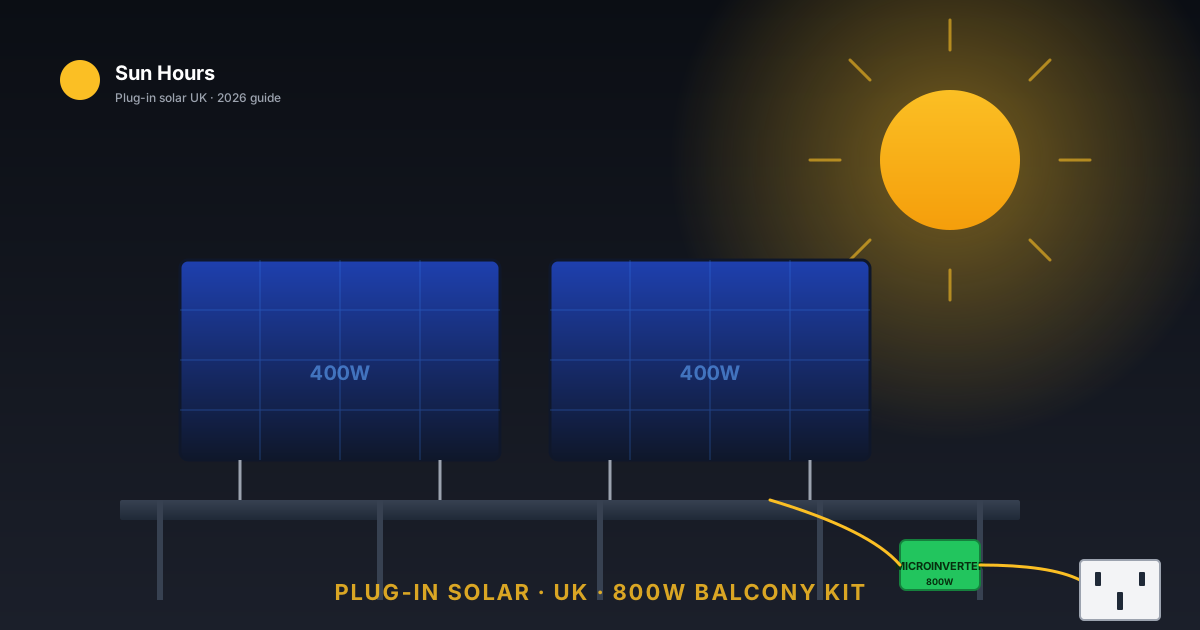
Plug-In & Plug-and-Play Solar is now legal in the UK
No scaffolding. No £10,000 price tag. Just a plug, a socket, and free electricity from your balcony or garden — in London, Manchester, Birmingham, Bristol, or anywhere across the UK. SI 2026/848 came into force on 27 August 2026 — the legal route is open, but no kit has been confirmed compliant yet. Here’s what to buy, what to check, and what to do while you wait.
Typical kit cost
£319–£499
No installer fee
Annual saving
£70–£110
DESNZ estimate, no export
Payback period
3–8 years
Then free power
Max per household
1 device
800VA / 800W AC cap
What is plug-in solar — and why does it matter?
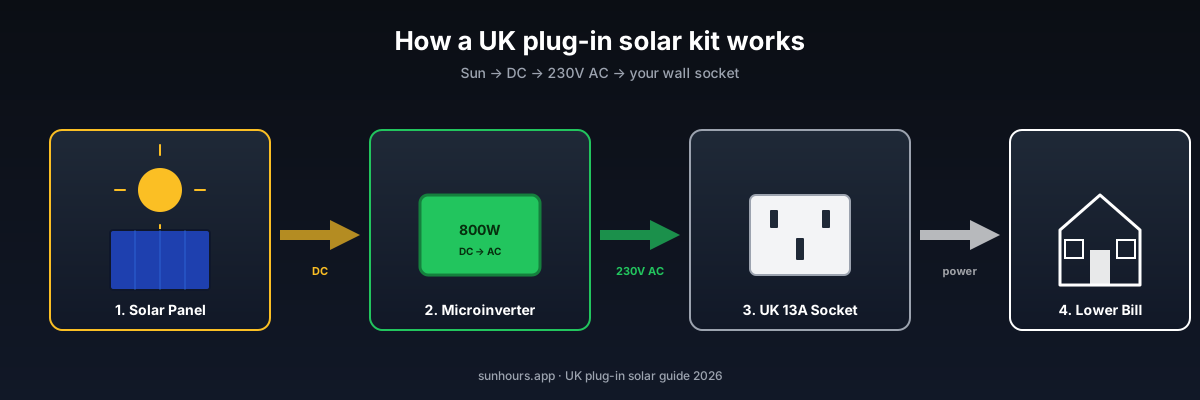
Plug-in solar panels (also called balcony solar, plug-and-play solar panels, or simply plug and play solar) are compact kits containing one or two solar panels and a microinverter. The microinverter converts the panels' DC output to 230V AC — the same electricity your home uses — and plugs into a standard 13A socket.
From that point, your appliances automatically draw from solar first. Your smart meter slows down. Your bill drops. No account needed. No export tariff paperwork. No roof work. That's why the “plug and play” name has stuck — because that is genuinely all there is to it.
Plug-in solar sat in a legal grey area for years — existing wiring regulations were written for fixed, professionally-installed systems and never anticipated a solar generator going into a standard socket. Energy Secretary Ed Miliband announced plans to change that on 24 March 2026. DESNZ published the Interim Product Specification on 16 June 2026 and ran a public consultation that closed 30 June. Lidl and Iceland were named as early retail partners back in March; B&Q, Amazon, Asda, Currys, Screwfix, and Wickes joined a follow-up government roundtable in June.
Germany already has over 1 million systems installed. SI 2026/848 is made and in force from 27 August 2026 — certified UK kits are expected in shops in late summer or early autumn 2026, once manufacturers finish certification and retailers get stock. Whether you're in a London flat, a Manchester terrace, a Bristol semi, an Edinburgh tenement, or a Cardiff new-build — if you can't do rooftop solar, plug and play solar panels are your answer.
Side by side
Plug-in solar vs rooftop solar — UK 2026
Two different products for two different households. Plug-in solar suits renters, flat-dwellers, and anyone wanting a £300–£500 starter system. Rooftop solar suits homeowners ready to invest £5,000–£8,000 for full bill displacement.
| Plug-in solar (800W) | Rooftop solar (4 kWp) | |
|---|---|---|
| Typical cost | £300–£500 kit (£260 entry from City Plumbing, ~£499 EcoFlow STREAM) | £5,000–£8,000 fully installed (panels + inverter + scaffolding) |
| Install time | 30 minutes — clamp the panel, plug into 13A socket | 1–3 days — scaffolding, roof work, electrician, sign-off |
| Planning permission | Not required for non-permanent installs (balcony, garden frame) | Permitted development in most cases; listed buildings and conservation areas need consent |
| DNO notification | Self-notify online (G98 framework, up to 800W) | Installer notifies DNO; G98/G99 application via certified contractor |
| MCS certification | Not required — but the kit itself must be assessed compliant on the ENA Type Test Register under the DESNZ spec (none are, yet) | Required for SEG export tariff eligibility |
| Annual output (UK avg) | 650–950 kWh/year (south-facing, unshaded) | 3,500–4,500 kWh/year |
| Annual savings + SEG | £70–£110 bill savings (DESNZ estimate). Assume £0 SEG — it needs a separate MCS-certified install | £700–£1,200 bill savings + £300–£600 SEG export income |
| Payback period | 3–6 years | 8–12 years |
| Renter-friendly | Yes — portable, take with you when you move | No — fixed to the property |
| Best for | Renters, flats, terraced houses, anyone wanting £300 to dip a toe in | Homeowners aiming for full bill displacement and SEG income |
Plug-in figures: UK 800W south-facing systems, satellite irradiance annual averages × 0.80 performance ratio; savings range reflects DESNZ's own impact assessment. Rooftop figures: typical 4 kWp install, UK MCS data and Energy Saving Trust guidance. One device permitted per household under current grid-connection rules (the spec itself allows one per circuit, but that needs a separate G98 amendment with no date yet). Batteries excluded from interim spec.
How it works
Sun → DC → 230V AC → your wall socket
A UK plug-and-play solar kit has four moving parts: a solar panel, a microinverter, a 13A socket, and your existing home wiring. The microinverter does the work of any rooftop inverter — just smaller and certified for direct plug-in.
Before you buy
3 things to do while you wait for certified kits
01
Check your consumer unit
Older homes (pre-2008) may have Type AC RCDs, which aren't designed for plug-in solar. You need a Type B RCD. A quick check by an electrician costs far less than a kit — worth doing first.
02
Find your south-facing spot
A south, south-west, or south-east facing balcony, garden, or shed roof is ideal. Even a south-facing fence works. Avoid heavily shaded spots — a 20% shade can cut output by 50% or more.
03
Download Sun Hours — know when your panels shine
Once your kit is in, the question becomes: when do I run the dishwasher? Charge the car? Sun Hours gives you a 7-day kWh forecast for your exact postcode — just enter your postcode and peak output. Free. No account.
Get it free on Google Play →Day one
Kit arrived? Your go-live checklist
Whether you're self-installing a verified kit or having a CPS-registered electrician connect one now, the same six checks apply on the day your system goes live. Note: only one device is permitted per household under current grid rules, and batteries are not covered under the interim spec.
✅Check the ENA register — not just the box
A CE or UKCA mark alone doesn't mean it's compliant with the new socket route. Look for the specification declaration and QR code on the label, then verify the exact model on the ENA Connect Direct Type Test Register before you plug in. No verified listing, no socket install — contact the retailer or use a hardwired connection instead.
🧭Mount the panel south-facing
Balcony rail, garden frame, or shed roof — south, south-east, or south-west, unshaded between 10am and 4pm. This is the single biggest factor in your output.
🔗Connect panel to inverter first
Wire the panel to the microinverter via the MC4 connectors before plugging the inverter's mains cable in. Connecting in this order matters for a safe start-up.
🔌Plug in, then pair the app
Plug the microinverter into a standard 13A socket. Open the manufacturer's app — EcoFlow app, or S-Miles for Hoymiles — and pair over Wi-Fi to confirm it's generating.
📋Notify your DNO (G98)
Required within 28 days of connecting — not optional, but usually quick. Many retailers and electricians file this for you; confirm who's doing it before you finish.
🛡️Tell your home insurer
A quick email or call. Some policies require notification of new electrical generation equipment — skipping it could affect a future claim.
☀️Download Sun Hours and start timing your usage
Get a 7-day kWh forecast for your postcode so you know exactly when to run the washing machine, dishwasher, or EV charger to use your free electricity instead of paying for grid power.
Get it free on Google Play →Best kits right now
Top 5 plug-in & plug-and-play solar deals in the UK
Prices checked and updated 1 July 2026. Always verify before buying — deals change.
01
EcoFlow STREAM 800W Balcony Solar Kit
🏆 Top PickThe official UK government partner product. Two 400W panels + 800W microinverter in one box. Modular — add a STREAM battery later without replacing anything. Anti-islanding certified, Wi-Fi monitoring via the EcoFlow app. The most complete plug-and-play solar kit available in the UK right now.
02
EcoFlow STREAM 800W Microinverter
💸 DIY Budget PickBuy just the inverter, source two 400W panels separately (from ~£57 each at City Plumbing or Screwfix). Full 800W plug-and-play solar system for around £240–£250 total. IP67 waterproof, MPPT, Wi-Fi app control included. Best entry-level value on the UK market — just note a single panel alone only gets you ~400W, not the full 800W.
03
Hoymiles HMS-800W-2T Micro Inverter
⭐ 4.5★ · 755 ReviewsThe inverter professional installers across London, Manchester, and Birmingham reach for first. Dual independent MPPT trackers mean each panel works at its own peak — even with partial shade. Integrated Wi-Fi, S-Miles Cloud monitoring app, 12-year warranty extendable to 25. Pair with any two 400W panels for a complete 800W plug-in solar system.
04
APsystems EZ1-M 800W Micro Inverter
✅ Amazon's ChoiceAmazon's Choice for UK balcony solar — 4.3★ from 233 verified buyers, 50+ sold in the past month. VDE certified plug-and-play inverter with Wi-Fi and Bluetooth monitoring. Dual MPPT, IP67 waterproof. Connect to any two 400W panels and you have a full 800W plug and play solar setup, ready to wire in.
05
Coming Soon: 7 Retailers Confirmed — Amazon, Asda, B&Q, Currys, Lidl, Screwfix, Wickes
✅ Legal since 27 Aug 2026Lidl and Iceland were named as early government partners in March 2026; Amazon, Asda, B&Q, Currys, Screwfix, and Wickes joined a retailer roundtable in June — DESNZ's official list of seven now runs Amazon, Asda, B&Q, Currys, Lidl, Screwfix, and Wickes. SI 2026/848 came into force on 27 August 2026, so certified kits can now legally use a standard socket — but as of our last check, none of the seven has a product on sale, and no plug-in solar device on the ENA register has been assessed compliant. DESNZ's own impact assessment estimates £400–£600 per complete kit, with £500 as its central assumption.
Kits from EcoFlow, Hoymiles, and APsystems are available now, but none of the four above is confirmed on the ENA Type Test Register as compliant with the new specification. Buying one today and self-installing via a socket is not yet the compliant route — the legal option for these specific products remains a hardwired connection by a CPS-registered electrician. Check our certified-kits tracker before assuming any kit is socket-ready.

Know exactly when your panels will generate — before they even arrive.
Sun Hours is the free app for solar owners (and soon-to-be solar owners) in the UK. Enter your postcode and your system's peak output — get a 7-day kWh forecast and hourly curve showing when your panels hit their best. Plan your washing, EV charging, and high-draw appliances around the sun. No account. No tracking. No faff.
ROI calculator
How much could plug-in solar save you?
Enter your postcode, panel setup, and energy rates — get your estimated annual savings, SEG income, and payback period in seconds.
Most UK balcony setups use 1–2 panels
Plug-in & plug-and-play solar UK — common questions
27 Aug 2026
Legal since (SI 2026/848)
0
Kits confirmed compliant
800W / house
Max output, per household
DESNZ published its consultation response on 16 Jul 2026 and SI 2026/848 came into force on 27 Aug 2026 as planned. Manufacturer certification is the remaining step: at our last check, three registered microinverters (Anker, GoodWe, InstaGroup) were all still assessed non-compliant, and none of the seven partner retailers had a product on sale.