
Is plug-in solar legal in the UK? The 2026 rules: G98, PAS 63100, DNO notification — now superseded by SI 2026/848; see our 27 August legality guide.
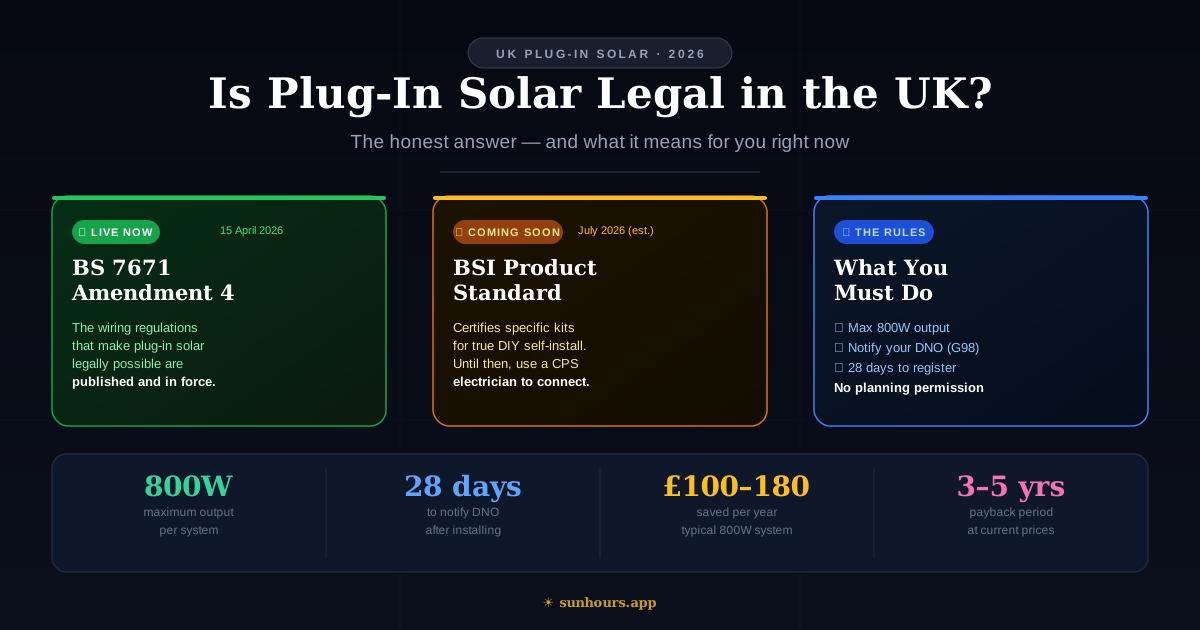
Update, 3 July 2026: the picture below reflects how things looked in May. Since then, DESNZ opened and closed a formal consultation on the actual enabling regulations. Read the current status → for what's genuinely changed.
The short answer
Not yet, as of the original May 2026 version of this article — see the update above for where things actually stand now. Plug-in solar was expected to be legal in the UK during 2026, and we were mid-transition. Two things had happened, and one was still pending.
What's already in force
BS 7671 Amendment 4 — the update to the UK's electrical wiring regulations — was published and came into effect on 15 April 2026. This is the legal foundation that makes plug-in solar possible. Before it, connecting any generation equipment to a standard domestic socket was not permitted under UK wiring rules. That restriction is now gone.
This matters because it means manufacturers can now design and certify products for the UK market, retailers can stock them, and households can legally have systems installed.
What's still coming
Before you can simply walk into Lidl, buy a kit, and plug it in yourself, one more piece needs to land: the BSI product standard. This is the specification that certifies exactly which plug-in solar devices meet UK safety requirements. It's expected around July 2026.
Until that standard publishes, there's no approved UK product list. European CE marks and German VDE certification don't automatically apply post-Brexit. The safest and most compliant route right now is to buy a kit and have it connected by a CPS-registered electrician via a hardwired fused spur — typically costing £250–£450 for the installation work.
Once the BSI standard lands, fully DIY self-installation of approved kits will be compliant. The government has confirmed kits will be in shops "within months," with summer 2026 as the working target.
The three rules you need to know
1. 800W maximum output
All plug-in solar systems under the new framework are capped at 800W. This is the safety limit designed to prevent overloading UK ring-main circuits. Two 400W panels is the standard configuration — which also happens to be what EcoFlow's STREAM kit ships as.
2. Notify your DNO within 28 days
Even though no permission is needed upfront, you are required to notify your Distribution Network Operator (DNO) — the company managing your local electricity grid — under G98 regulations. This is a simple online form, not an approval application. You have 28 days after connecting to submit it. Skipping this can result in your system being disconnected.
Your DNO is determined by your postcode. You can find yours at energynetworks.org.
3. No planning permission required
Installing panels on a balcony rail, garden fence, shed roof, or flat roof does not require planning permission in most cases, provided they don't protrude more than 200mm from the surface and don't alter a listed building. For the vast majority of plug-in solar setups, planning is not a factor.
What about renters?
The Renters' Rights Act 2025 changed the position for tenants. Landlords can no longer unreasonably refuse a request to make energy improvements. A portable plug-in solar kit that requires no structural drilling has a strong case for being classed as "reasonable." Put the request in writing, reference the Act and the BS 7671 compliance, and if refused, Citizens Advice can help.
What about export payments?
Not available for most plug-in systems. The Smart Export Guarantee (SEG) requires MCS certification, which plug-in kits cannot achieve. Any electricity your system generates beyond what your home uses in real time flows to the grid unpaid. To earn export income, you need a full MCS-certified rooftop installation by an approved installer.
What to check before you buy
- Your consumer unit: Older homes (pre-2008) may have Type AC RCDs, which aren't designed for reverse power flow from plug-in solar. You need a Type B RCD. Worth a quick electrician check before purchasing a kit.
- Your orientation: South, south-west, or south-east facing is ideal. Even 20% shade can cut output by half.
- Your insurance: Let your home insurer know. Some policies require notification of any new electrical additions. Failing to notify could affect a claim.
The bottom line
The framework is in place. The regulations are live. Kits are available now (EcoFlow STREAM 800W from around £499 on Amazon UK), and Lidl, Iceland, and Amazon are all confirmed retail partners for the UK rollout. The remaining gap is the BSI product standard — expected July 2026 — after which fully DIY self-installation becomes straightforward.
If you want to act now: buy a kit, have a CPS electrician connect it, notify your DNO within 28 days. You'll be generating free solar electricity this summer.

Got a plug-in solar kit — or about to? Know exactly when to run it.
Once your kit is connected, Sun Hours tells you the best hours to run your dishwasher, washing machine, or charge your devices — a 7-day kWh forecast for your exact postcode, personalised to your system's output. Free on Android. No account needed.