
The UK passed 2 million solar installations in March 2026 — a record 27,000 in one month. The numbers behind the surge.
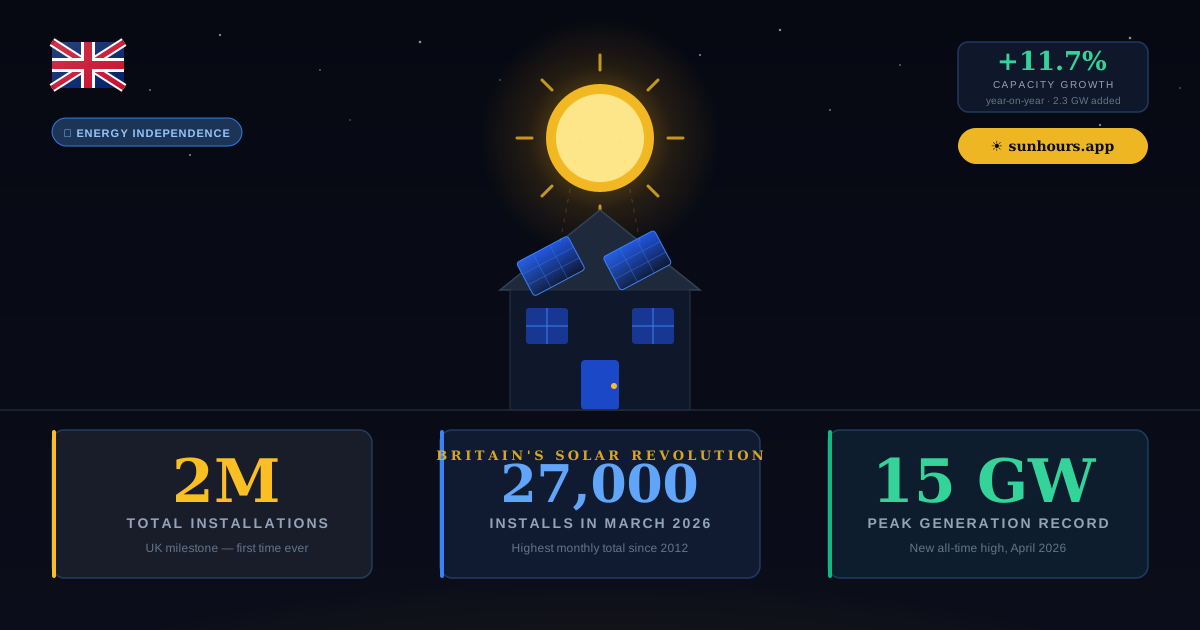
The moment Britain hit 2 million
On a quiet statistical release on 30 April 2026, the UK government confirmed what solar advocates had been watching approach for months: the total number of solar installations across Britain — rooftop panels on homes, schools and businesses, plus utility-scale solar farms — has passed 2 million for the first time.
That number is a milestone, but the story behind it is about speed. 27,000 new solar installations were completed in March 2026 alone — the highest monthly total since the feed-in tariff boom of 2012. Two thirds of those were residential rooftop systems: ordinary homeowners putting panels on their houses and disconnecting a slice of their electricity bill from the fossil fuel market.
Solar capacity grew by 11.7% over the past year, adding 2.3 GW of clean generation to Britain's grid — roughly equivalent to two large gas power stations, but without the fuel costs or the price exposure.
Why energy security is now the sales pitch
For most of the past decade, the case for home solar rested on payback periods, feed-in tariffs, and environmental credentials. That calculus shifted sharply when Russia invaded Ukraine and gas prices tripled. It shifted again in early 2026, when the outbreak of conflict in Iran sent oil markets into a fresh wave of volatility and pushed the cost of imported gas back to uncomfortable levels.
Energy Secretary Ed Miliband, announcing the figures, framed it explicitly: the goal is to get Britain "off the fossil fuel rollercoaster". Every rooftop panel installed is one fewer unit of electricity that has to be priced off an international gas market subject to geopolitical shocks.
For homeowners, the logic has become straightforward: solar panels generate electricity whose effective cost is fixed at zero — regardless of what happens in the Strait of Hormuz or the North Sea spot market. The 27,000 households that installed in March 2026 didn't just cut their bills. They opted out of the volatility entirely.
What the government is doing next
The March 2026 record didn't happen by accident. Three specific policy decisions are accelerating the deployment pipeline:
Springwell Solar Farm received planning consent this spring, making it the largest power-producing solar farm ever approved in UK history. When complete, it will add several gigawatts of utility-scale capacity to the grid.
Plug-in solar panels — the low-cost balcony and outdoor units that have transformed solar uptake across Germany and France — are set to arrive in UK shops within months. The government is fast-tracking the standards framework that has blocked their sale until now. No scaffolding, no DNO approval process, no five-figure upfront cost. For the millions of renters and flat-dwellers who have been locked out of solar economics, this is the change that matters most.
Solar as standard on new homes will become a requirement in England under updated building regulations, meaning every new house built from the implementation date will arrive with panels as part of the base specification — not an optional extra.
On top of those structural changes, the government announced £100 million in additional funding for the Social Housing Fund, targeting up to 57,000 solar installations for social housing tenants this financial year. The explicit aim: make sure the benefits of the solar revolution reach households who can't organise or finance their own installation.
The 15 GW generation record
The installation milestone arrived in the same month Britain set a new peak solar generation record of 15 GW — the first time that figure had ever been crossed on the GB grid. National Energy System Operator (NESO) data confirmed the reading. At that moment, solar was covering roughly 40% of Britain's entire electricity demand.
For context: when the previous monthly installation record was set back in 2012, the entire UK solar fleet was producing around 2–3 GW on its best days. The same favourable spring conditions now produce five times as much electricity. The fleet has simply grown to the point where a good April afternoon moves national energy markets.
What this means if you have solar panels
The national numbers have a direct personal translation. More capacity, more data, and — with plug-in solar imminent — more neighbours with panels means better peer benchmarking, more awareness of peak windows, and a faster-improving forecast ecosystem.
The hours when GB solar sets national records are almost always the hours when your roof is also at its peak. Knowing exactly when those windows fall — not just in general, but for your specific postcode, cloud cover forecast, and system size — is what lets you act on them. Running the washing machine, the dishwasher, or charging the car during your personal solar peak is the difference between free electricity and grid electricity.
Sun Hours shows you that window: a 7-day kWh forecast personalised to your postcode and your system's output, updated with each day's weather. Free on Android. No account needed.
The road to 3 million
At March 2026's pace, the UK would cross 3 million total installations in roughly three years. But the policy pipeline — plug-in solar in shops, mandatory solar on new homes, the Social Housing Fund rollout, and continued falls in hardware costs — points to acceleration rather than plateau.
Britain's solar revolution isn't a political slogan. It's 27,000 households a month deciding that sunlight is a more reliable energy supplier than a gas market tied to events on the other side of the world. The 2 million mark is where that decision crossed from niche into mainstream.

Your panels are part of Britain's 2 million — see exactly what they're generating
The UK just hit 2 million solar installations. If your panels are one of them, Sun Hours shows you a personalised 7-day kWh forecast based on your postcode and your system's real-world output — so you always know your best windows for free solar power. Free on Android.